
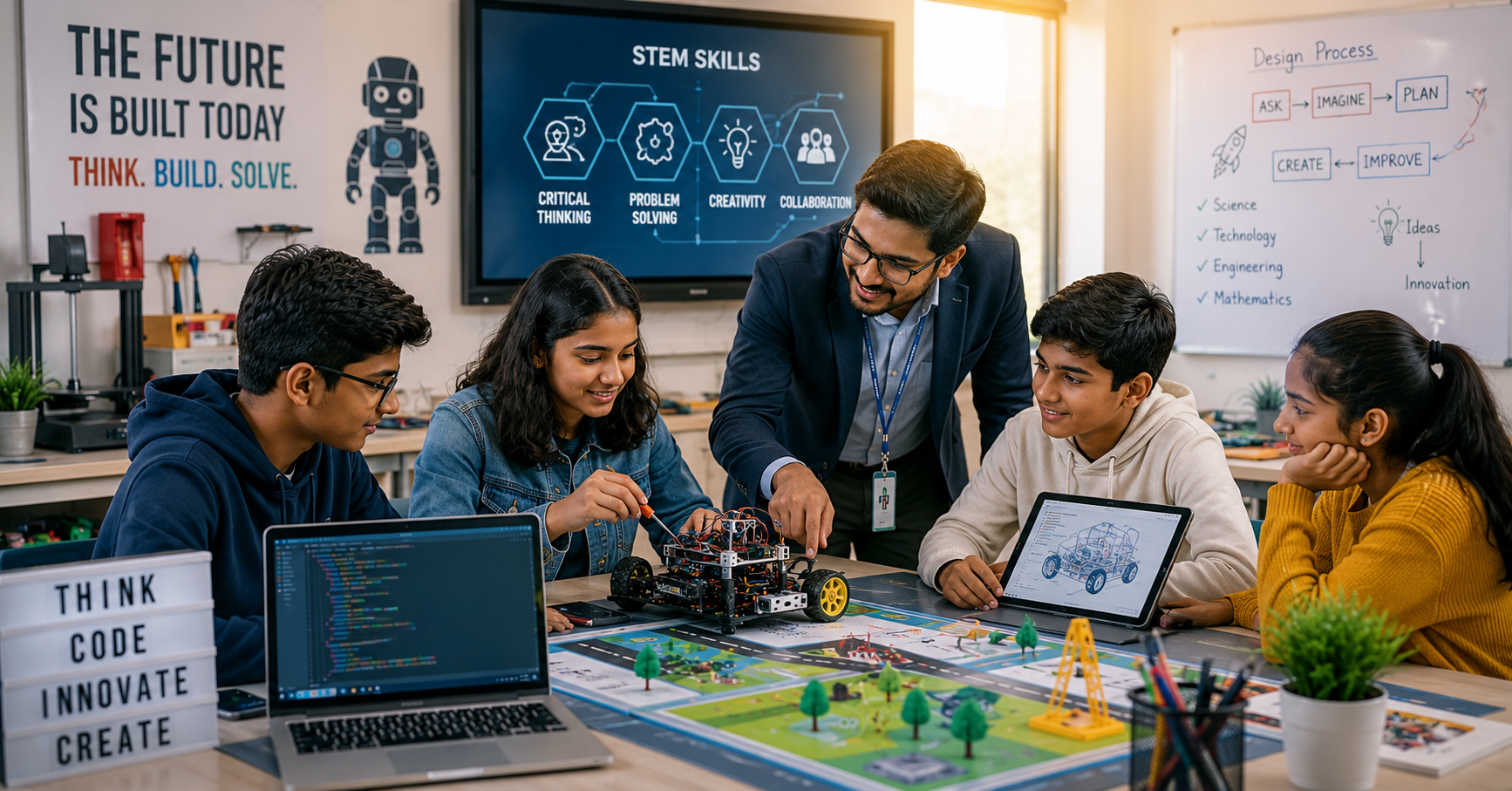
Children today are growing up in a world shaped by technology, scientific discovery and constant innovation. Simply memorising information is no longer enough. Students also need to know how to ask questions, analyse information, solve problems, work with others and apply what they learn to real situations.
This is where STEM education in schools can make a meaningful difference.
STEM stands for Science, Technology, Engineering and Mathematics. Rather than treating these subjects only as separate areas of study, STEM learning encourages students to connect ideas, investigate problems and find practical solutions.
For parents, the importance of STEM education goes beyond preparing children for future careers. When thoughtfully implemented, it can support curiosity, critical thinking, creativity, collaboration and problem-solving from an early age.
For parents currently choosing a school that integrates STEM education can play a significant role in shaping a child’s academic journey, career readiness, and lifelong success.
Quick Answer: What Is the Importance of STEM Education in Schools for Future Careers?
STEM education helps students develop critical thinking, creativity, collaboration, communication, and problem-solving skills through Science, Technology, Engineering, and Mathematics. These skills are increasingly essential for future careers across almost every industry.
What Is STEM Education?
STEM education brings together four interconnected areas:
- Science: Understanding the natural world through observation, questioning and experimentation.
- Technology: Using tools and technology to explore ideas, create solutions and solve problems.
- Engineering: Designing, building, testing and improving solutions.
- Mathematics: Using numbers, patterns, measurement, logic and data to understand and solve problems.
The strength of STEM comes from the connection between these areas.
For example, a student designing a simple structure may need science to understand materials, mathematics to make measurements, engineering to develop the design and technology to test or improve it.
This makes learning more connected to how knowledge is used outside the classroom.
Why Is STEM Education Becoming More Important?
The future workplace demands more than memorization and exam scores.
Employers increasingly seek individuals who can:
- Think critically
- Solve complex problems
- Work collaboratively
- Adapt to changing technologies
- Innovate confidently
Future Careers Already Being Shaped by STEM
- Artificial Intelligence
- Robotics Engineering
- Aerospace Technology
- Software Development
- Cybersecurity
- Biotechnology
- Data Science
- Environmental Engineering
- Renewable Energy
- Medical Technology
Students exposed to STEM learning from an early age often develop greater confidence in these emerging fields.
Why Is STEM Education Important in Schools?
1. Develops Critical Thinking
STEM learning encourages students to look at a problem before immediately looking for an answer.
They may need to ask:
- What is causing the problem?
- What information do we have?
- What could be changed?
- Which solution might work best?
- How can we test our idea?
This process encourages children to analyse information, consider alternatives and make reasoned decisions.
2. Builds Problem-Solving Skills
Problem-solving is at the heart of effective STEM learning.
Students may be given a challenge with no single obvious answer. They have to understand the problem, develop an idea, test it and make improvements.
Importantly, this also teaches children that getting something wrong is not necessarily failure. A failed experiment or unsuccessful design can provide information that helps them improve the next attempt.
Research on integrated STEM education identifies real-world problems, inquiry, design and cooperative work as important principles of effective STEM learning.s creativity.Encourages Creativity and Innovation
3. Encourages Creativity and Innovation
STEM is sometimes mistakenly viewed as being only about science and mathematics. In reality, effective STEM activities can require considerable creativity.
Students may need to think of several possible solutions, design something new or find a different way of approaching a challenge.
This encourages children to move from simply asking, “What is the answer?” to asking, “What else could we try?”
STEM education naturally strengthens these competencies.
Future-Ready Student Checklist
- Logical reasoning
- Collaboration skills
- Leadership abilities
- Technical understanding
- Growth mindset
4. STEM Improves Academic Performance
STEM learning encourages students to connect concepts across multiple subjects.
For example:
Science + Mathematics
Students use mathematical formulas to analyze scientific experiments.
Engineering + Technology
Students apply technology tools to build innovative solutions.
This integrated learning approach improves understanding and retention.
5. Makes Learning More Hands-On
One of the biggest advantages of STEM education is the opportunity to learn by doing.
Instead of only reading about a scientific principle, students can observe it through an experiment. Instead of only learning about engineering concepts, they can design, build and test something.
Hands-on experiences can make abstract concepts easier to understand because students can connect classroom knowledge with something they can see, test or change.
Research reviews also suggest that STEM approaches can support learning outcomes, although the impact varies depending on factors such as age, subject, teaching method and implementation.
From STEM to STEAM: How Hands-On Learning Works
STEM focuses on:
S – Science
T – Technology
E – Engineering
M – Mathematics
STEAM adds another important dimension:
A – Arts
The addition of Arts does not mean that STEM subjects become less important. Instead, it can encourage students to bring creativity, communication, design and visual thinking into problem-solving.
For example, when students develop a prototype, the engineering may determine whether it works, mathematics may help with measurements, technology may support the process, while artistic and design thinking can influence how the final solution looks and communicates its purpose.
This is one reason hands-on STEAM learning can provide a broader learning experience.

These qualities benefit students throughout life.
How Aikya World School Brings STEM Learning to Life
At Aikya World School, STEM learning extends beyond textbook-based understanding through opportunities for hands-on exploration.
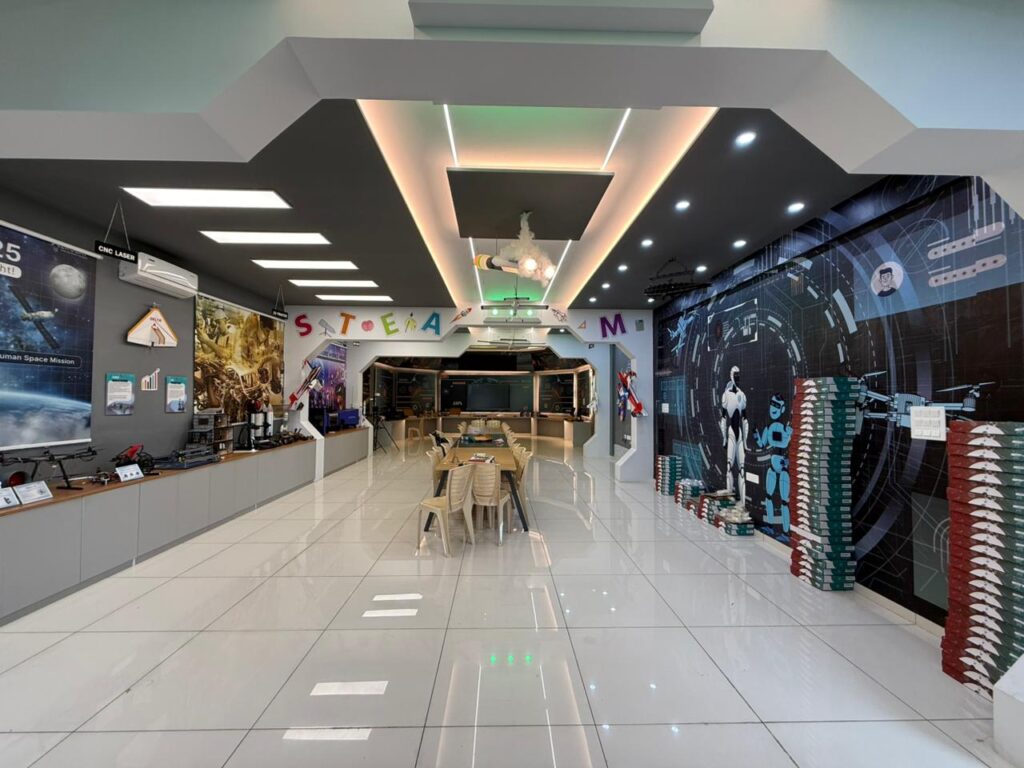
The school has a dedicated STEAM Lab, designed to give students a space where they can explore Science, Technology, Engineering, Arts and Mathematics through practical learning experiences.
Students can engage with areas such as:
- Robotics
- Coding
- Science and STEM projects
- Innovation challenges
- Engineering projects
- Design-oriented activities
- Artificial Intelligence basics
These experiences give students opportunities to experiment, create, test ideas and learn from the process.
The school’s approach also includes hands-on learning through a student toolkit, supporting an environment where children can move from learning a concept to exploring how that concept works in practice.
The aim is not simply to introduce children to technology. It is to help them develop the habits of questioning, experimenting, creating and improving.
Statistics Every Parent Should Know
- STEM careers are projected to remain among the fastest-growing employment sectors globally.
- Technology-related jobs continue to expand across industries.
- Employers increasingly prioritize problem-solving and digital literacy skills.
- Students exposed to project-based learning often demonstrate stronger engagement and retention.
These trends highlight why STEM education is becoming a key factor in future career readiness.
STEM Education and Teamwork
STEM learning does not always happen individually.
Many STEM challenges require students to work together. One student may suggest an idea, another may test it, while others may record observations or help improve the design.
Through this process, children learn to:
- Listen to different ideas
- Share responsibilities
- Explain their thinking
- Give and receive feedback
- Resolve differences
- Work towards a common solution
Research on collaborative learning in STEM has found positive overall effects, while also showing that outcomes depend on the technology and teaching approach used.
STEM and Academic Learning
STEM education should not be viewed as something separate from academic learning.
In fact, a well-designed STEM activity can bring several academic concepts together.
For example, a simple design challenge might involve:
Science – understanding how something works
Mathematics – measuring and calculating
Engineering – designing and testing
Technology – using tools or digital resources
This gives students an opportunity to apply what they have learned rather than treating knowledge as something that exists only for an examination.
How STEM Can Improve Student Engagement
Children are naturally curious. They want to know why something happens and what will happen if they change something.
STEM learning can use that curiosity as part of the learning process.
Instead of simply providing an answer, teachers can give students a question or challenge and allow them to investigate it.
That shift can make learning more active.
A student who is designing a solution, testing a model or investigating an experiment is not simply receiving information. They are participating in the learning process.
STEM Education and Future Careers
STEM education can also help students develop a foundation for future study and careers in areas such as engineering, medicine, technology, data science, research and other science- and technology-related fields.
However, schools should not present STEM only as preparation for a particular career.
The skills developed through STEM—such as critical thinking, problem-solving, collaboration, creativity and adaptability—can be useful across many different academic and professional pathways.
A 2025 umbrella review covering 22 meta-analyses found positive effects of STEM education across learning outcomes, including higher-order thinking and cognitive outcomes, while also noting that effectiveness varies by educational level, subject and teaching method.
What Should Parents Look for in a STEM-Focused School?
Parents evaluating STEM education should look beyond whether a school simply has the word “STEM” in its curriculum.
Consider asking:
Does the school provide hands-on experiences?
Look for opportunities where students can experiment, build, test and improve ideas.
Are STEM subjects connected?
Good STEM learning should help children understand connections between different disciplines rather than treating every subject as completely separate.
Do students work on real problems?
Problem-based and inquiry-driven activities can help children understand how classroom knowledge applies to real situations.
Is there room for creativity?
STEM should encourage students to explore different solutions instead of expecting every child to arrive at exactly the same answer.
Does the school have appropriate facilities?
Labs, technology resources, learning tools and spaces for practical exploration can support meaningful STEM experiences.
Are students encouraged to learn from mistakes?
A strong STEM environment should make experimentation and iteration part of learning.
STEM Education Is About More Than Technology
It is easy to associate STEM education with computers, robots and advanced technology. But technology is only one part of the picture.
At its core, STEM education is about thinking, questioning, investigating and solving problems.
A child observing how plants grow, measuring changes, making predictions and recording results is already developing STEM thinking.
Similarly, a student designing a structure, testing it and changing the design after it fails is practising engineering thinking.
The value comes from the learning process not simply from the equipment being used.
The Role of STEM in Holistic Development
STEM can contribute to more than academic development.
When students participate in collaborative projects and practical challenges, they can also develop confidence, communication, persistence and teamwork.
They learn that complex problems may require multiple attempts and that different perspectives can contribute to better solutions.
This makes STEM particularly relevant to a broader approach to education where academic knowledge is combined with creativity, collaboration and practical learning.
Schools with CBSE curriculum that integrate STEM education provide students with a significant advantage in a rapidly evolving world.
Conclusion
The importance of STEM education in schools lies not only in preparing children for technology-driven careers. Its greater value is in helping students become curious thinkers and capable problem-solvers.
When STEM is taught through meaningful questions, hands-on activities, collaboration and real-world challenges, children get opportunities to understand concepts and apply them.
The progression from STEM to STEAM can take this further by bringing creativity and design into the learning experience.
At Aikya World School, the dedicated STEAM Lab and hands-on learning approach are part of creating opportunities for students to explore, experiment and develop future-ready skills alongside their academic learning.
If you are exploring admissions for your child, we invite you to schedule a campus visit, connect with our admissions team, and discover how Aikya World School can support your child’s journey toward lifelong success.
Enquire Today | Book a Campus Tour | Speak With Our Admissions Team.