
Choosing the right curriculum is one of the most important decisions parents make for their child’s education. A curriculum influences not only what children learn, but also how they understand concepts, solve problems, communicate, collaborate and apply their knowledge.
For parents researching CBSE schools in Bangalore, one of the most common questions is: What does the CBSE curriculum actually include, and is it the right choice for my child?
The Central Board of Secondary Education (CBSE) provides the academic framework followed by affiliated schools across different stages of school education. Its curriculum includes subjects, learning outcomes, teaching approaches and assessment guidelines, with an increasing emphasis on conceptual understanding, competency-based learning and application of knowledge.
This guide explains the CBSE curriculum in simple terms, including its structure by stage, key features, competency-based learning, the 2026–27 curriculum resources, assessment, competitive examinations, STEM education and what parents should consider when choosing a CBSE school.
Quick Answer: What Is the CBSE Curriculum?
The CBSE curriculum is the academic framework prescribed by the Central Board of Secondary Education for its affiliated schools. It covers areas such as subjects, learning outcomes, pedagogy and assessment.
CBSE’s curriculum places emphasis on conceptual understanding, application of knowledge, competency development, higher-order thinking and real-world problem-solving rather than relying only on memorisation. CBSE’s own curriculum documents describe the importance of hands-on experience, competency-based learning and applying knowledge and skills to real-life situations.
What Is the CBSE Curriculum?
The CBSE curriculum provides a structured framework for teaching and learning in CBSE-affiliated schools. It is not simply a list of chapters or textbooks. It includes learning objectives, subject areas, competencies, pedagogical approaches and assessment expectations.
Depending on the child’s class and stage of education, the curriculum can include languages, mathematics, sciences, social sciences, arts, skill education, health and physical education and other areas.
The exact subjects and requirements vary by class and academic stage, so parents should refer to the current CBSE curriculum for their child’s grade rather than assuming that the same structure applies throughout school.
CBSE Curriculum by Stage
A useful way for parents to understand CBSE education is to look at how learning changes as children progress through school.
Foundational / Early Years
The foundational stage focuses on building the basic abilities children need for future learning. At this age, learning is developmentally appropriate and places importance on language, early numeracy, communication, social-emotional development, physical development and learning through play and activities.
Parents should expect younger children to learn through stories, conversations, games, exploration, movement and hands-on experiences rather than through a heavily textbook-driven approach.
Primary Stage
During the primary years, children gradually strengthen their reading, writing, mathematical and general understanding skills. Learning becomes more structured while continuing to use activities, projects, discussions and practical experiences.
This stage is particularly important for building strong foundational concepts because these concepts support more complex learning in later classes.
Middle Stage
The middle stage introduces students to more specialised and conceptually demanding learning. Students increasingly work with subject-specific ideas, experiments, projects, discussions and application-based tasks.
CBSE’s current curriculum resources also include skill-oriented and interdisciplinary learning opportunities at this stage. For 2026–27, CBSE states that Kaushal Bodh is mandatory for Classes VI–VIII, providing a specific example of the growing role of skill education in this stage.
Secondary Stage
The secondary stage, generally covering Classes IX and X, involves deeper subject learning and greater academic structure. Students develop conceptual understanding while preparing for the requirements of the secondary-level curriculum and board assessment.
Parents should check the current CBSE scheme of studies because subject requirements, options and assessment details can vary according to the class and academic session.
Senior Secondary Stage
Classes XI and XII provide greater opportunities for subject choice and specialisation. Students select subjects according to the available combinations, their interests and their future academic plans.
At this stage, conceptual clarity becomes particularly important for students considering higher education and entrance examinations. However, school curriculum and entrance-examination preparation should not be treated as exactly the same thing.
Important: The exact subjects, subject combinations, learning expectations and assessment structure vary by stage and class. Parents should always refer to the latest official CBSE curriculum for the relevant academic session.
Why Do Parents Prefer the CBSE Curriculum?
Parents may consider CBSE for several reasons, including its national-level framework, availability across different parts of India and the familiarity of its curriculum among schools and families.
For families that relocate between cities, staying within the same education board may make the transition easier, although the actual transfer experience depends on factors such as the child’s class, school and subject choices.
Parents may also appreciate the curriculum’s emphasis on conceptual understanding, skills and application rather than viewing education purely through the lens of examination scores.
However, the suitability of any curriculum depends on the individual child’s needs, learning preferences and the quality of implementation at the school.
Key Features of the CBSE Curriculum
The CBSE education system is designed to help students develop both academic knowledge and practical skills.
Competency-Based Learning
Students learn how to apply knowledge rather than simply memorize facts.
Experiential Learning
Activities, projects, case studies, and real-world applications help improve understanding.
Skill Development
The curriculum promotes communication, collaboration, creativity, and leadership skills.
Continuous Assessment
Student progress is evaluated through multiple methods rather than relying solely on final examinations.
Future-Focused Education
Modern CBSE schools integrate technology, innovation, and emerging learning methodologies.
The important distinction is that these principles need to be translated into actual classroom experiences. A curriculum document alone does not determine how effectively students learn; school-level teaching practices also matter.
CBSE Curriculum 2026–27: What Has Changed?
Parents looking at the CBSE curriculum for 2026–27 should use the official CBSE Academic website as the primary source because not every change applies to every class.
The official CBSE academic portal currently provides the detailed 2026–27 curriculum and also highlights the Curriculum Framework for Computational Thinking (CT) and Artificial Intelligence (AI) for Classes III–VIII. CBSE has also published 2026–27 skill-education resources, including Kaushal Bodh for Classes VI–VIII.
For example, the CT and AI framework describes a phased approach in which computational thinking is introduced and developed across Classes III–VIII, with more advanced CT, interdisciplinary projects and introductory AI concepts in Classes VI–VIII.
This does not mean that every child across every CBSE class has the same new subjects or assessment structure. Parents should check the official curriculum applicable to their child’s specific class and academic year.
Official CBSE Resources
Parents can use the following official resources when checking the latest curriculum:
- CBSE Academic Curriculum: Detailed curriculum and scheme of studies
- CBSE CT and AI Framework: Computational Thinking and Artificial Intelligence for Classes III–VIII
- CBSE Skill Education Resources: Current skill-education books and support material
- CBSE Students & Parents Resources: Sample papers, marking schemes, subject information and other academic resources
This approach is more reliable than relying on general claims about a “new CBSE curriculum” because curriculum changes can apply differently across stages and classes.
CBSE Curriculum and Competency-Based Learning
Competency-based learning is one of the most important concepts parents should understand when looking at modern CBSE education.
In simple terms, competency-based education focuses on what students know, understand and can do with their knowledge. It moves beyond asking whether a child can remember information and places greater importance on applying concepts, reasoning, solving problems and demonstrating learning.
CBSE’s competency-based education resources describe competency-based learning as involving the application of knowledge and skills in real-world situations. They also distinguish competency-based assessment from approaches that focus primarily on whether content has been memorised.
What Can Competency-Based Learning Look Like?
Instead of asking a student only to reproduce a definition, a competency-oriented task might ask the student to:
- Apply a scientific concept to an everyday situation
- Analyse information before reaching a conclusion
- Explain how they arrived at an answer
- Solve an unfamiliar problem
- Interpret data
- Connect concepts across subjects
- Work collaboratively on a project
- Present and defend an idea
This is why competency-based learning is closely connected with critical thinking, creativity, communication, problem-solving and higher-order thinking.
For parents, the key takeaway is simple: learning is not only about completing chapters. Students are increasingly expected to demonstrate their understanding and apply what they have learned.
Benefits of CBSE Curriculum for Students
The benefits of CBSE curriculum extend far beyond examination performance.
1. Strong Conceptual Understanding
Students are encouraged to understand concepts and apply them rather than depending entirely on memorisation.
2. Critical Thinking and Problem-Solving
Application-based and competency-oriented learning can give students opportunities to analyse information, reason through problems and develop solutions.
3. Skill Development
Communication, collaboration, creativity, problem-solving and other transferable skills can be developed through classroom activities, projects and practical learning.
4. Opportunities for Holistic Development
Students can participate in academics alongside sports, arts, activities, projects and leadership experiences, depending on what the school offers.
5. National-Level Curriculum Framework
CBSE provides a common national curriculum framework for its affiliated schools, which can be useful for families who move between cities.
6. Preparation for Further Education
A strong conceptual foundation can support students as they progress to higher classes and eventually pursue higher education.

How CBSE Supports Preparation for Competitive Examinations
CBSE and competitive-examination preparation should be viewed as related but separate.
CBSE students often benefit from a strong NCERT foundation because NCERT textbooks and concepts are widely used in preparation for national-level entrance examinations. However, students still need dedicated preparation for the specific requirements of each examination.
This is one of the key reasons many parents prefer CBSE schools, as CBSE schools prepare for competitive exams
Strong NCERT Foundation
Most competitive exams are based heavily on NCERT concepts.
Students studying the CBSE syllabus gain a significant advantage.
JEE Preparation
Students preparing for JEE may use the concepts learned through school-level mathematics, physics and chemistry as part of their foundation. However, JEE preparation generally requires additional problem-solving practice and examination-specific preparation.
NEET Preparation
Similarly, school-level learning in biology, chemistry and physics can provide a foundation for students preparing for NEET. Students still need preparation specifically aligned with the examination’s syllabus, question format and competitive nature.
Olympiad and Other Examinations
Analytical thinking, conceptual understanding and problem-solving can be useful for students participating in Olympiads and other academic competitions. However, the preparation requirements differ from one examination to another.
The important point for parents is that following the CBSE curriculum alone should not be presented as equivalent to competitive-examination preparation.
Best Study Tips for CBSE Students
Academic success requires consistent learning habits rather than last-minute preparation.
Create a Study Schedule
A realistic timetable helps students balance learning, revision, activities, sleep and recreation.
Focus on Concept Clarity
Students should try to understand why an answer is correct rather than simply memorising it.
Revise Regularly
Short, consistent revision sessions can help students retain concepts over time.
Practise Application-Based Questions
Students should practise applying concepts to different situations, particularly when preparing for assessments that test higher-order thinking.
Solve Previous-Year and Sample Papers
For relevant classes and examinations, sample papers and previous-year papers can help students understand question formats and practise time management.
Maintain Healthy Habits
Adequate sleep, nutritious food, physical activity and breaks are important parts of a sustainable study routine.
Importance of STEM Education in Schools
STEM stands for Science, Technology, Engineering and Mathematics.
STEM learning can give students opportunities to connect concepts across disciplines and work on practical problems. It can encourage curiosity, experimentation, creativity, collaboration and problem-solving.
Why STEM Matters
STEM education can help students develop:
- Critical thinking
- Creativity
- Innovation
- Collaboration
- Problem-solving
- Scientific inquiry
- Logical reasoning
How STEM Can Complement CBSE Learning
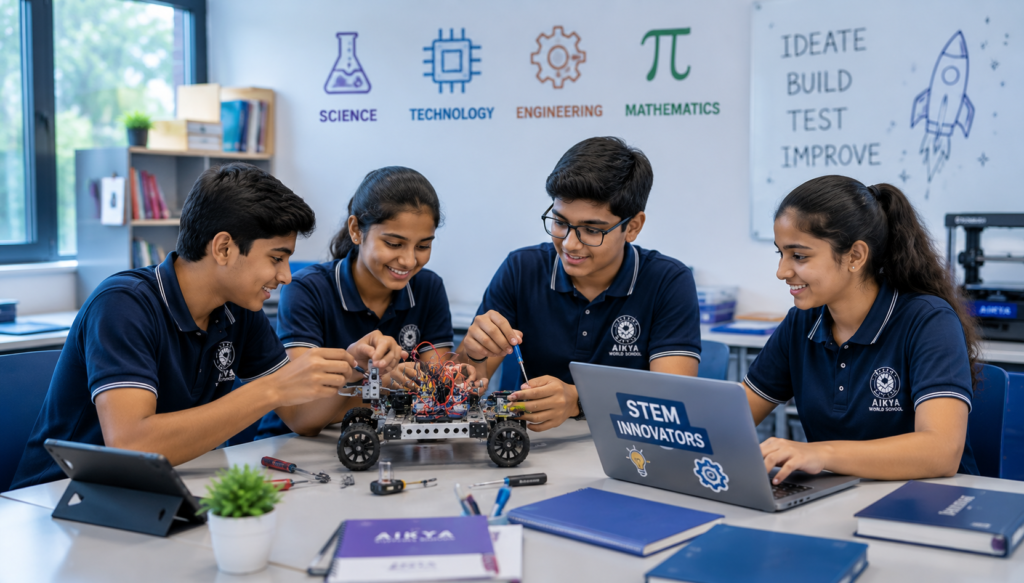
Schools may use project-based learning, coding, robotics, experiments, innovation challenges and scientific inquiry to give students practical opportunities to apply concepts.
However, these activities should be described as school-level implementations, rather than suggesting that every CBSE school provides exactly the same STEM programmes.
CBSE vs Other Education Boards
Parents often compare CBSE with ICSE and State Boards before making admission decisions.
| Feature | CBSE | ICSE | State Boards |
| Board framework | National | National | State-specific |
| Curriculum | Prescribed by CBSE | Prescribed by CISCE | Varies by state |
| Subject structure | Varies by class | Varies by class | Varies by state |
| Transfer Flexibility | Depends on school and class | Depends on school and class | Depends on state and school |
| Competitive-exam preparation | Students may benefit from NCERT foundation | Depends on individual preparation | Depends on curriculum and preparation |
How Parents Can Support Their Child’s Learning Journey
Parents do not need to teach every subject themselves to support their child’s education.
Some practical ways to help include:
- Encourage children to ask questions
- Maintain a consistent daily routine
- Provide a suitable study environment
- Focus on understanding rather than marks alone
- Encourage reading beyond textbooks
- Celebrate effort and progress
- Communicate with teachers
- Encourage sports, creative activities and hobbies
- Help children develop time-management skills
- Pay attention to emotional well-being
Children generally benefit when parents provide both structure and encouragement without creating unnecessary pressure.
How Technology Is Transforming the CBSE Learning Experience
Technology can support classroom learning when it is used purposefully.
Depending on the school, students may encounter:
- Digital learning platforms
- Interactive assessments
- Coding and robotics
- Virtual simulations
- Digital content
- Online collaboration tools
- Educational applications
The important factor is not simply whether a school has technology, but whether technology is being used to improve understanding, experimentation, collaboration and access to learning resources.
How the CBSE Curriculum Supports Holistic Development
Academic achievement is only one part of a child’s development.
A well-rounded school experience can give students opportunities to develop academically, physically, socially and emotionally.
One of the strengths of the CBSE curriculum is its focus on holistic development. Students are encouraged to participate in sports, arts, cultural activities, community service initiatives, and leadership opportunities alongside academics.
Key Areas of Holistic Development in CBSE Schools
Academic Growth
Conceptual learning and application-based activities can help students build subject knowledge and learning skills.
Physical Development
Sports and physical activities can support fitness while encouraging teamwork, discipline and resilience.
Social Development
Group projects, presentations, and collaborative learning help students improve communication and interpersonal skills.
Emotional Development
Children also need opportunities to develop self-awareness, empathy, confidence and the ability to manage challenges.
Holistic development therefore depends not only on the curriculum but also on the school’s culture, activities, teaching practices and learning environment.
A balanced educational experience helps children become confident learners and responsible citizens.
| CBSE Curriculum Benefits | How Students Benefit |
| Conceptual Learning | Better understanding of subjects |
| Competitive Exam Readiness | Strong JEE and NEET foundation |
| STEM Integration | Future career preparedness |
| Holistic Development | Balanced growth beyond academics |
| National Recognition | Easy school transfers across India |
| Skill Development | Communication, leadership, and critical thinking |
Why Choosing the Right CBSE School Matters
A curriculum alone cannot determine a child’s educational experience.
Two schools following the same CBSE curriculum can provide very different classroom experiences depending on their teachers, learning environment, infrastructure, activities and approach to student development.
Parents exploring CBSE schools should consider:
- Academic teaching quality
- Student-teacher interaction
- Experiential learning opportunities
- Sports and physical education
- Co-curricular activities
- STEM and technology facilities
- Life-skills development
- Student well-being
- Safety and campus environment
- Communication between school and parents
For families exploring the best CBSE schools in Bangalore, it is worth looking beyond rankings and facilities and understanding how the school actually implements the curriculum.
At Aikya World School, the learning environment combines academics with opportunities for innovation, creativity, leadership, sports and holistic development.
Final Thoughts
Understanding the CBSE curriculum helps parents make a more informed decision about their child’s education.
CBSE provides a structured academic framework while placing increasing emphasis on conceptual understanding, competencies, application of knowledge, skills and holistic development. The exact subjects, learning expectations and assessment structure vary according to the student’s stage and class, so parents should always refer to the latest official CBSE resources.
Ready to Explore Admissions?
- Book a Campus Visit
- Speak to Our Admissions Team
- Submit an Admissions Enquiry
- Discover the Aikya World School Difference
Your child’s future begins with the right educational foundation.
Frequently Asked Questions
1. What is the CBSE curriculum and how does it benefit students?
The CBSE curriculum focuses on conceptual understanding, competency-based learning, and holistic development while preparing students for higher education and future careers.
2. Why do parents prefer CBSE schools in Bangalore?
Many parents choose CBSE schools because of their national recognition, competitive exam alignment, and balanced academic approach.
3. How does the CBSE curriculum help students prepare for JEE and NEET?
The curriculum is closely aligned with NCERT textbooks, which form the foundation for most national entrance examinations.
4. What are the major benefits of the CBSE curriculum for students?
Benefits include conceptual learning, skill development, critical thinking, flexibility, national recognition, and career readiness.
5. How important is STEM education in CBSE schools?
STEM education helps students develop innovation, creativity, analytical thinking, and future-ready skills that are increasingly valuable in modern careers.