
Parents today want more than good marks for their children. They want them to become curious thinkers, confident problem-solvers and adaptable learners who can handle challenges in the real world.
This is where design thinking in schools can make a difference. Instead of simply memorising answers, students learn to understand problems, ask questions, explore ideas, create solutions and improve them through feedback.
For parents choosing a school, this approach can be an important sign that learning goes beyond textbooks and prepares children for future challenges.
What Is Design Thinking in Schools?
Design thinking is a human-centred approach to solving problems creatively. In schools, it encourages students to understand different perspectives before developing and testing solutions.
A typical design thinking process involves five stages:
- Empathise – understand people’s needs and experiences.
- Define – clearly identify the problem.
- Ideate – generate different possible solutions.
- Prototype – create a simple version of an idea.
- Test – try it, collect feedback and improve it.
The process is not always linear. Students may move between stages as they discover new information.
For example, instead of simply learning about waste management, students could identify waste-related problems in their school, brainstorm solutions, create a model recycling system and improve it after receiving feedback.
That turns a lesson into an active learning experience.
Why Is Design Thinking Essential in Schools?
Children will enter a world where many jobs and problems are still evolving. Therefore, education needs to develop skills that help students respond to unfamiliar situations.
Design thinking encourages:
- Creative thinking
- Critical thinking
- Problem-solving
- Collaboration
- Communication
- Empathy
- Innovation
- Decision-making
- Adaptability
What Does Research Say About Design Thinking in Schools?
Research on design thinking in K–12 education has explored how the approach is incorporated into school learning, the methods used to study it and its potential educational outcomes. A 2025 study, Review of research on design thinking in K–12 education, examined 40 empirical studies, highlighting growing research interest in design thinking while also identifying areas where further evidence is needed.
For an Indian school context, teachers can refer to the CBSE Design Thinking & Innovation Teacher’s Manual, which includes activities and teaching strategies to introduce students to design concepts, inquiry and problem-solving.
How Does Design Thinking Work in a Classroom?
Design thinking helps students understand problems, explore ideas and learn by doing develop practical solutions through a step-by-step process.
For example, students trying to reduce classroom waste can:
- Understand the problem: Observe how waste is generated in the classroom.
- Identify the cause: Discuss why students may be using or disposing of materials unnecessarily.
- Brainstorm solutions: Suggest ideas such as reusing materials or introducing labelled waste bins.
- Create a prototype: Develop a simple model or visual guide.
- Test and improve: Collect feedback and refine the solution.
This process encourages students to collaborate, consider different perspectives and learn from their mistakes. The CBSE Design Thinking and Innovation Teacher’s Manual provides examples of how design thinking can be introduced into school learning.
What Are the Benefits of Design Thinking in Education?
Design thinking provides opportunities for students to develop skills they can use in their academic work and everyday lives.
- Creativity: Encourages students to explore different ideas instead of relying on a single solution.
- Critical thinking: Helps students analyse problems and evaluate possible solutions.
- Problem-solving: Teaches students to break challenges into manageable steps.
- Collaboration: Gives students opportunities to share ideas and work towards a common goal.
- Empathy: Encourages students to understand other people’s needs and perspectives.
- Adaptability: Helps students use feedback to refine their ideas and learn from mistakes.
- Communication: Allows students to explain their thinking, present ideas and discuss improvements.
The benefits depend on how design thinking is taught and the opportunities students receive to practise these skills.
How Can Teachers Use Design Thinking Across Subjects?
Teachers can incorporate design thinking into different subjects to connect classroom knowledge with practical challenges.
- Science: Ask students to explore ways to conserve water or reduce waste.
- Mathematics: Encourage students to design a classroom layout using measurements and calculations.
- Social Studies: Invite students to identify ways to make a shared community space more accessible.
- Language: Ask students to create a story, poster or information guide for a specific audience.
- Art: Encourage students to develop a design, gather feedback and refine their work.
- Environmental Studies: Guide students in exploring solutions to problems such as excessive plastic use.
These activities help students apply what they learn while practising creativity, observation, communication and problem-solving.
Teachers looking for classroom ideas can refer to the IDEO Design Thinking for Educators toolkit.
How Can Schools Implement Design Thinking in India?
Schools can introduce design thinking through age-appropriate projects, collaborative activities and practical problem-solving exercises.
- Connect projects to curriculum goals: Ensure activities reinforce relevant subject knowledge and learning objectives.
- Encourage questions: Give students opportunities to investigate problems and explore different perspectives.
- Introduce hands-on activities: Let students draw, build, model or test possible solutions.
- Promote teamwork: Encourage students to exchange ideas and explain their decisions.
- Use feedback constructively: Help students identify what works and what needs improvement.
- Encourage reflection: Ask students what they learned, what challenged them and how they would improve their solution.
The National Education Policy 2020 identifies design thinking among the contemporary subjects that may be introduced at relevant educational stages.
How Can Parents Identify Design Thinking in a School?
Parents can look for signs that a school encourages children to explore ideas, understand problems and develop solutions rather than simply follow instructions.
During a school visit, consider asking:
- Are students encouraged to ask questions? Check whether children can explore topics and express their own ideas.
- Do students participate in practical projects? Ask about activities involving models, experiments, prototypes or creative problem-solving.
- Can children learn from mistakes? Find out how teachers encourage students to improve their work after receiving feedback.
- Is collaboration part of classroom learning? Look for opportunities for students to share ideas and work in teams.
- Are projects connected to academic subjects? Ask how practical activities support classroom learning.
- How do teachers assess progress? Find out whether they consider the thinking process, participation and learning alongside the final outcome.
Design thinking does not have to be taught as a separate subject. Schools can incorporate its principles into everyday lessons, projects and experiential learning activities.
What Is the Difference Between Design Thinking and STEM?
Design thinking and STEM education are related, but they serve different purposes.
- STEM stands for Science, Technology, Engineering and Mathematics. It brings these subject areas together to help students understand concepts and investigate challenges.
- Design thinking is a problem-solving approach. It helps students understand people’s needs, generate ideas, develop prototypes and improve solutions through testing.
- STEM builds subject knowledge: Students apply scientific principles, mathematical reasoning and engineering concepts to problems.
- Design thinking encourages exploration: Students investigate what needs to be solved and consider different ways to address it.
- The two can work together: Students designing a water-saving system might use scientific knowledge and mathematical measurements while following the design thinking process.
- Both can support practical learning: When combined appropriately, they give students opportunities to connect classroom concepts with real-world challenges.
In schools, integrating design thinking with STEM activities can help students apply their knowledge while developing creativity, collaboration and problem-solving skills.
Final Thoughts
Design thinking in schools helps students move beyond memorising information to understanding problems, exploring ideas and developing practical solutions. Through activities that involve observation, creativity, collaboration and testing, students learn to think critically, consider different perspectives and improve their ideas through feedback.
When teachers integrate design thinking into classroom lessons and hands-on projects, students get opportunities to connect academic concepts with real-world challenges.
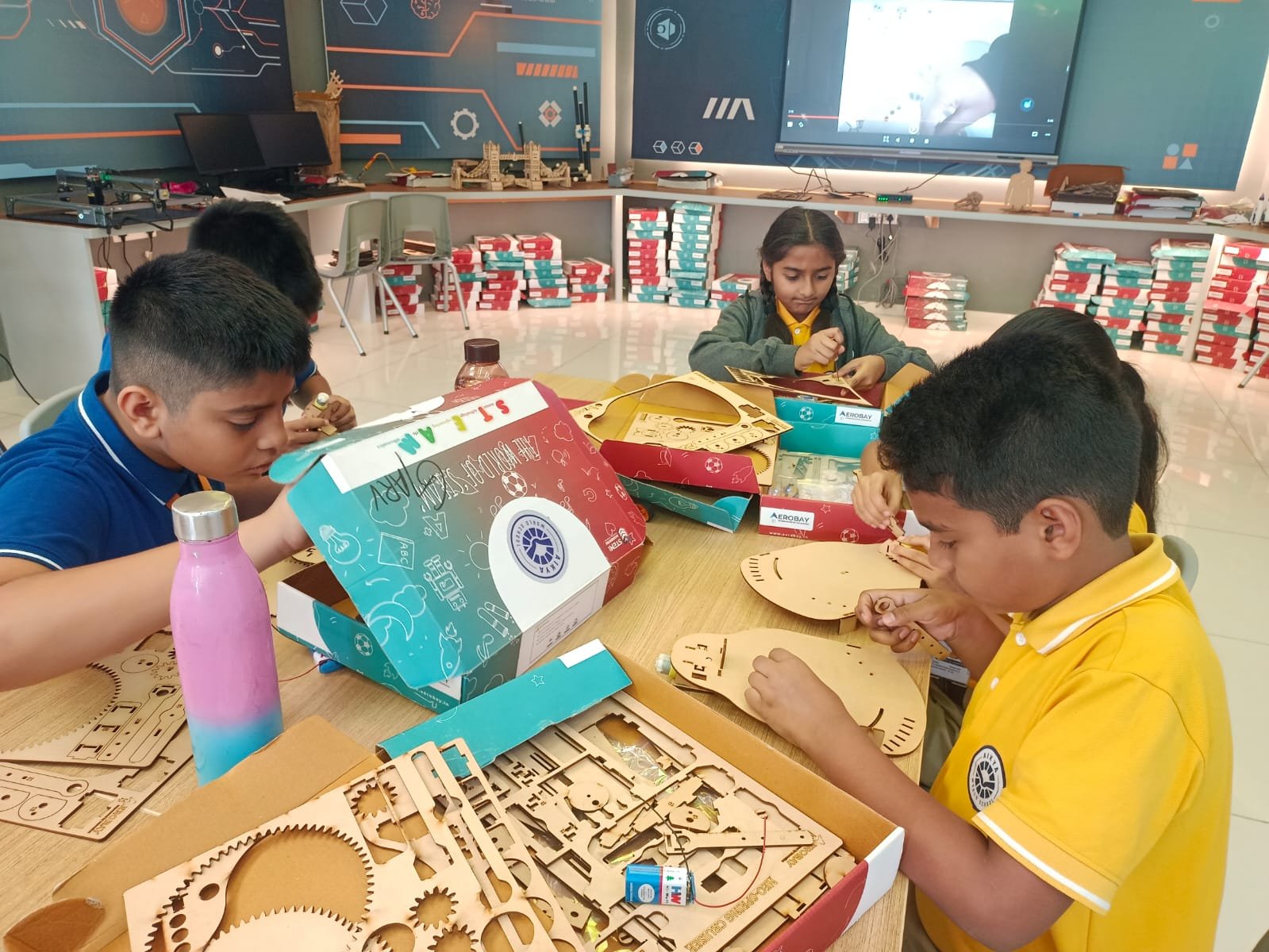
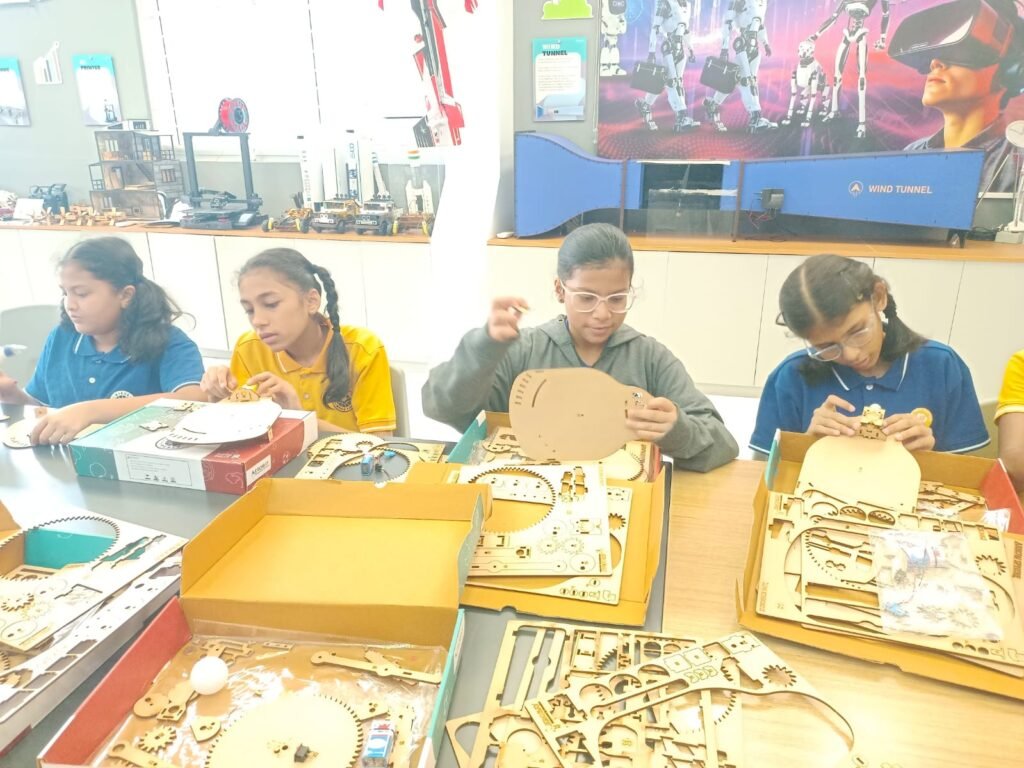
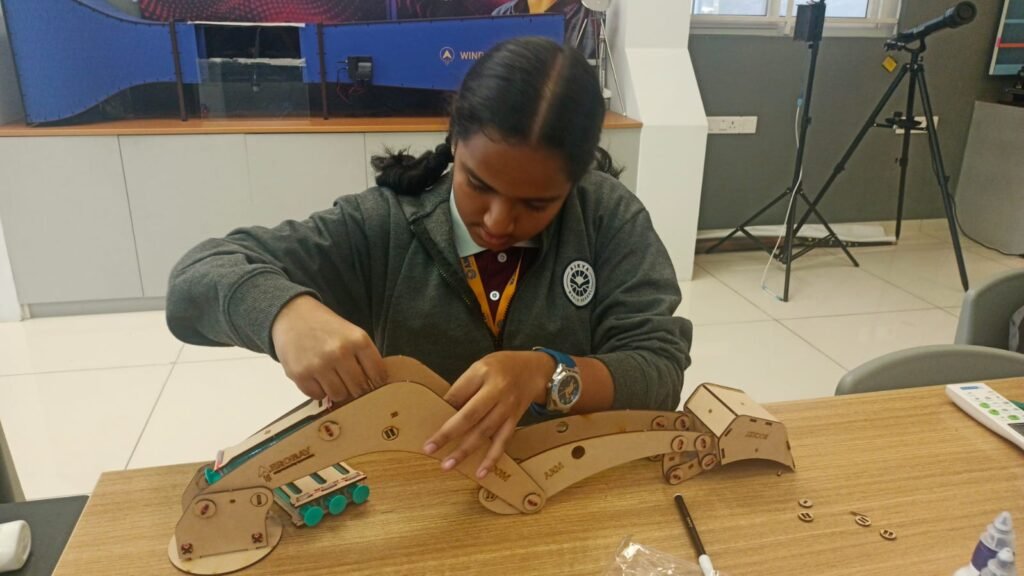
At Aikya World School, experiential learning and hands-on STEAM activities provide opportunities for students to explore concepts and apply their learning in practical ways. By creating an environment where questions, experimentation and reflection are encouraged, schools can help children develop skills that support learning both inside and outside the classroom.
Frequently Asked Questions
What is design thinking in schools?
Design thinking in schools is a problem-solving approach where students understand a problem, generate ideas, create solutions, test them and improve them.
What skills does design thinking develop?
It develops creativity, critical thinking, problem-solving, empathy, collaboration, communication, decision-making and innovation.
Is design thinking suitable for young children?
Yes. It can be adapted to age-appropriate activities involving play, observation, storytelling, building, questioning and simple problem-solving.
Is design thinking the same as STEM?
No. STEM focuses on science, technology, engineering and mathematics. Design thinking is a problem-solving approach that can be used within STEM as well as other subjects.
Why is design thinking important for students?
It helps students move beyond memorisation and develop the ability to approach unfamiliar problems creatively and thoughtfully.