
Parents today want more than good marks for their children. They want them to become curious thinkers, confident problem-solvers and adaptable learners who can handle challenges in the real world.
This is where design thinking in schools can make a difference. Instead of simply memorising answers, students learn to understand problems, ask questions, explore ideas, create solutions and improve them through feedback.
For parents choosing a school, this approach can be an important sign that learning goes beyond textbooks and prepares children for future challenges.
What Is Design Thinking in Schools?
Design thinking is a human-centred approach to solving problems creatively. In schools, it encourages students to understand different perspectives before developing and testing solutions.
A typical design thinking process involves five stages:
- Empathise – understand people’s needs and experiences.
- Define – clearly identify the problem.
- Ideate – generate different possible solutions.
- Prototype – create a simple version of an idea.
- Test – try it, collect feedback and improve it.
The process is not always linear. Students may move between stages as they discover new information.
For example, instead of simply learning about waste management, students could identify waste-related problems in their school, brainstorm solutions, create a model recycling system and improve it after receiving feedback.
That turns a lesson into an active learning experience.
Why Is Design Thinking Essential in Schools?
Children will enter a world where many jobs and problems are still evolving. Therefore, education needs to develop skills that help students respond to unfamiliar situations.
Design thinking encourages:
- Creative thinking
- Critical thinking
- Problem-solving
- Collaboration
- Communication
- Empathy
- Innovation
- Decision-making
- Adaptability
Research supports this approach. A 2024 meta-analysis of 25 studies found that design thinking had a positive effect on student learning, including creativity, engagement, motivation, problem-solving and academic achievement.
This makes design thinking more than a classroom trend. It can become a practical way of developing future-ready learners.
What Does Design Thinking Look Like in Classrooms?
Design thinking does not necessarily require complicated equipment or a separate subject.
It can be integrated into everyday learning.
For instance:
Science: Students identify an environmental problem and design a possible solution.
Mathematics: Students use measurements and calculations to solve a practical design challenge.
Social Science: Students explore a community problem from different people’s perspectives.
Language: Students interview others, understand their viewpoints and communicate a solution.
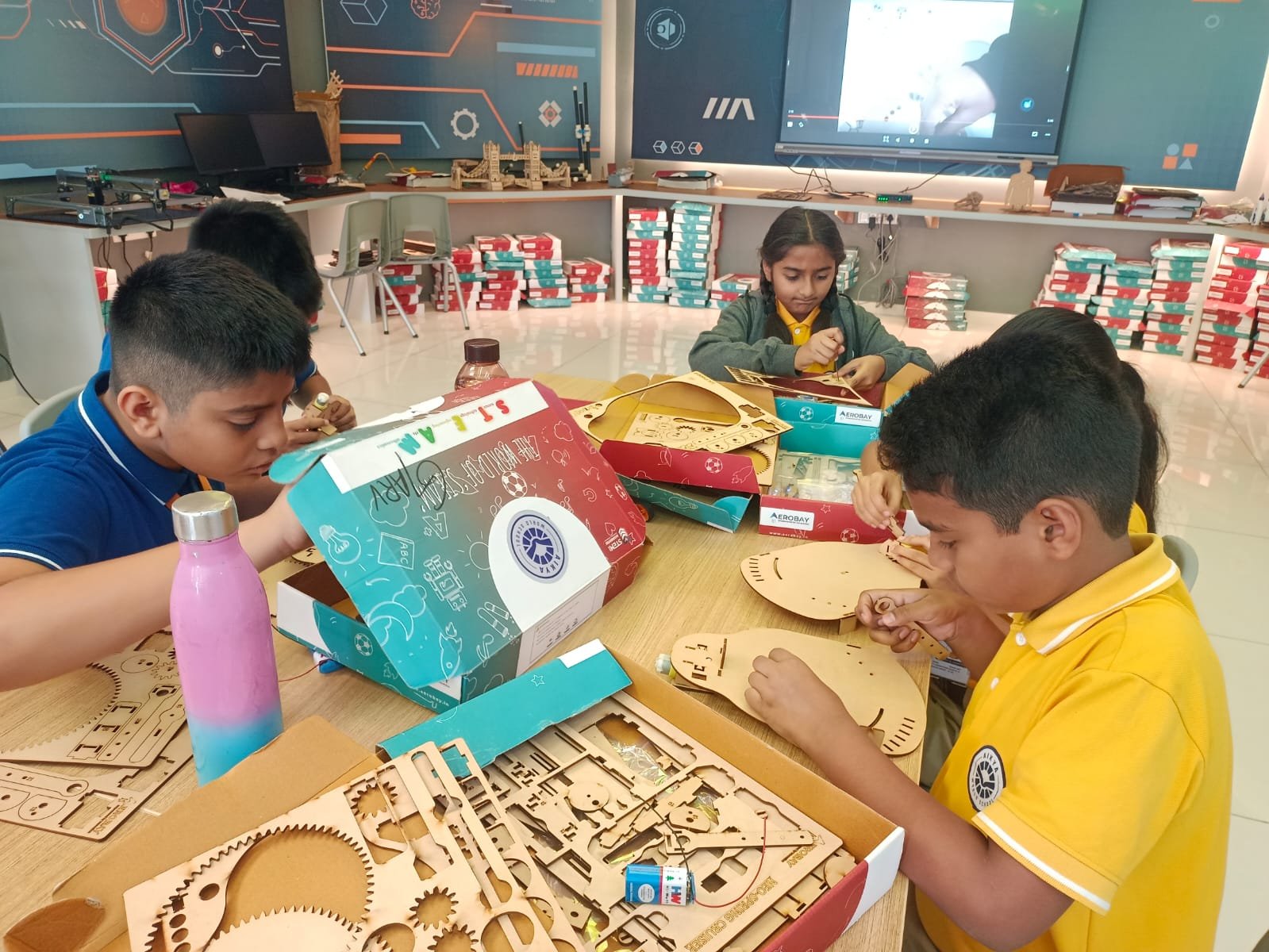
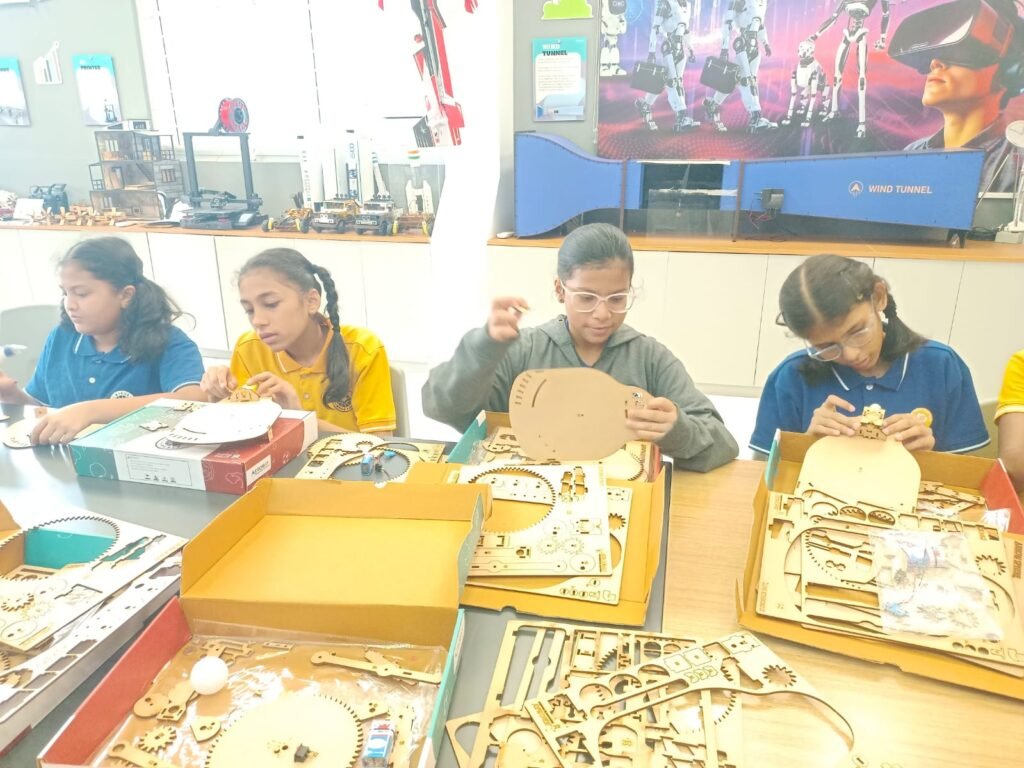
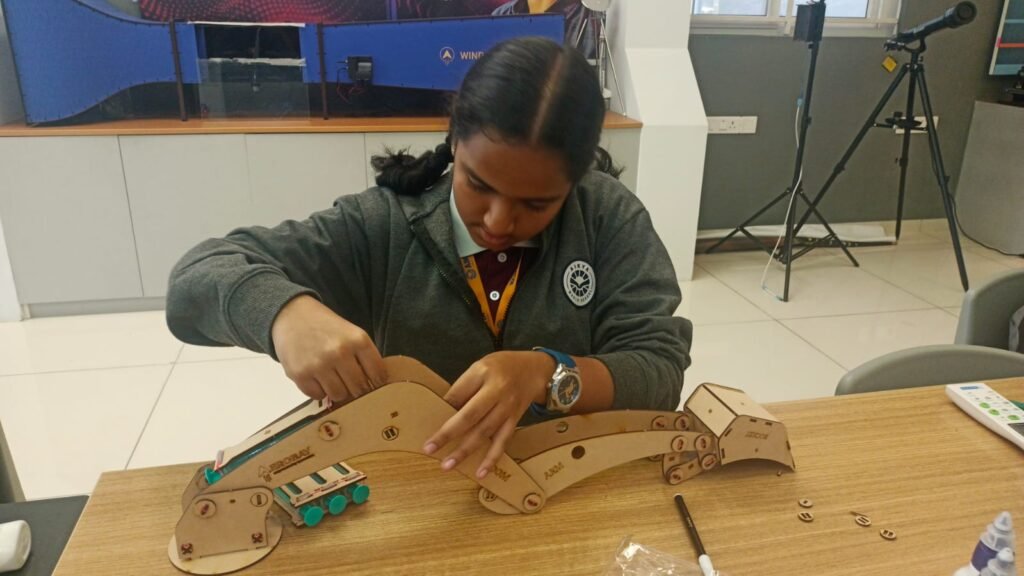
STEAM: Students combine science, technology, engineering, arts and mathematics to design and test a prototype.
The important difference is that students are not simply given a problem with one correct answer. They are encouraged to explore, question, create and improve.
How Does Design Thinking Work in Action?
Imagine a teacher asks:
“How can we make our school playground more enjoyable for everyone?”
Students might begin by speaking to classmates and observing how the playground is used.
They could then identify problems such as limited seating, overcrowding or lack of interesting activities.
Next, groups brainstorm ideas and create simple models or drawings. They present their solutions, receive feedback and make improvements.
The final outcome is important, but the learning process is even more valuable.
Students learn that a first idea does not have to be perfect. They can test it, learn from mistakes and try again.
This builds confidence and a healthier attitude towards failure.
What Are the Benefits of Design Thinking in Education?
One of the biggest advantages is that students become active participants in learning.
1. Builds Problem-Solving Skills
Students learn to break complex problems into smaller, manageable parts and develop possible solutions.
2. Encourages Creativity
Instead of searching immediately for one correct answer, children explore multiple possibilities.
3. Develops Empathy
Understanding other people’s needs helps students become better listeners and more thoughtful decision-makers.
4. Makes Learning Meaningful
Real-world problems give students a reason to apply what they learn in class.
5. Builds Collaboration
Design challenges often involve teamwork, discussion, feedback and shared decision-making.
6. Encourages Innovation
Students learn that ideas can be tested, changed and improved rather than accepted as final.
How Does Design Thinking Shape Future Innovators?
Innovation is not simply about inventing something new. It also involves recognising problems and finding useful ways to solve them.
Design thinking gives students opportunities to practise this mindset from an early age.
It teaches children to ask:
- Why does this problem exist?
- Who is affected by it?
- What could we do differently?
- What happens if our idea fails?
- How can we improve our solution?
These questions encourage curiosity and independent thinking qualities that can support students well beyond school.
The National Education Policy 2020 also places emphasis on contemporary capabilities such as artificial intelligence, design thinking, innovation and holistic development, reinforcing the growing importance of future-oriented learning in education.
Why Do the Best Schools in Bangalore Embrace Design Thinking?
For parents comparing Best Schools in Bangalore, the presence of design thinking should not be judged simply by whether a school uses the term on its website.
Look for evidence of hands-on, interdisciplinary and problem-based learning.
“What do students actually do with what they learn?”
A school that encourages children to experiment, collaborate, create and reflect is more likely to provide meaningful opportunities to develop these skills.
How Can Parents Identify Genuine Design Thinking in a School?
Before choosing a school, parents can ask:
- Are students given real-world problems to solve?
- Do children work on projects and prototypes?
- Can students suggest their own ideas?
- Is collaboration part of classroom learning?
- Are mistakes treated as opportunities to learn?
- Does the school integrate STEAM and experiential learning?
- Can the school show examples of student projects?
These questions can reveal much more than simply asking whether a school “offers design thinking.”
Design Thinking and Holistic Learning
Design thinking fits naturally into holistic education because it develops more than academic knowledge.
Students use their thinking skills while also developing communication, emotional awareness, teamwork and creativity.
For younger children, this might involve simple activities such as building something with everyday materials, finding different ways to solve a classroom problem or designing something that helps another person.
As students grow older, challenges can become more complex and interdisciplinary.
The goal is not to turn every lesson into a major project. Instead, it is to create regular opportunities for children to think, question, create and improve.
Why Design Thinking Matters in Indian Schools
Design thinking matters in Indian schools because it helps students move beyond simply memorising answers and learn how to think, question, create, and solve real-world problems. In a country as diverse and rapidly changing as India, students may face challenges related to technology, sustainability, communities, and everyday life that do not have one fixed answer.
By encouraging empathy, creativity, collaboration, experimentation, and problem-solving, design thinking helps children become more adaptable and confident learners.
It also supports the growing emphasis on experiential and competency-based learning in Indian education, preparing students with skills that are useful not just for exams, but for higher education, careers, entrepreneurship, and everyday decision-making.
Final Thoughts
Design thinking in schools is ultimately about changing how children approach learning and problems. Instead of asking only, “What is the right answer?”, students learn to ask, “What can I discover, create and improve?”
For parents, this can be an important consideration when choosing a school that supports academic growth, creativity, confidence and future-ready skills.
At Aikya World School, Jayanagar, learning is supported by a holistic approach that includes 21st-century skills, experiential learning and a dedicated STEAM Lab. Parents exploring schools in South Bangalore can visit the campus to understand the learning environment and approach firsthand.
Interested in exploring Aikya World School?
Visit the campus, speak with the admissions team and learn more about the 2026–27 admissions process.
Frequently Asked Questions
What is design thinking in schools?
Design thinking in schools is a problem-solving approach where students understand a problem, generate ideas, create solutions, test them and improve them.
What skills does design thinking develop?
It develops creativity, critical thinking, problem-solving, empathy, collaboration, communication, decision-making and innovation.
Is design thinking suitable for young children?
Yes. It can be adapted to age-appropriate activities involving play, observation, storytelling, building, questioning and simple problem-solving.
Is design thinking the same as STEM?
No. STEM focuses on science, technology, engineering and mathematics. Design thinking is a problem-solving approach that can be used within STEM as well as other subjects.
Why is design thinking important for students?
It helps students move beyond memorisation and develop the ability to approach unfamiliar problems creatively and thoughtfully.