

Introduction
Choosing a school is one of the most important decisions parents make for their children. In a city like Bangalore, where parents have access to schools following different boards, teaching approaches and fee structures, the admission process can sometimes feel overwhelming.
If you are planning school admissions in Bangalore for the 2027–28 academic year, it helps to start early. But applying early is only one part of the process. Parents also need to understand eligibility, admission timelines, documents, school visits, curriculum choices and what makes a school the right fit for their child.
This guide explains the school admission process in Bangalore, what parents should prepare, questions to ask before choosing a school and how to approach the 2027–28 admission cycle with greater confidence.
What Is the School Admission Process in Bangalore?
While every school has its own procedure, the following steps are common.
Step 1: Research and Shortlist Schools
Start by identifying schools that suit your child’s age, grade, location and educational needs.
Consider:
- Curriculum or board
- Distance from home
- Teaching approach
- School environment
- Sports and co-curricular activities
- Safety
- Fees
- Student support
- Facilities
- Parent communication
Don’t shortlist a school simply because it appears high on a “top schools” list. Think about whether the school is actually suitable for your child.
Step 2: Check Eligibility
Before applying, check whether your child meets the school’s requirements for the grade.
This is particularly important for children entering Nursery, Kindergarten or Grade 1, where age cut-off dates can differ between schools.
Step 3: Check Admission Availability
Ask whether admissions are open for the required grade and whether seats are currently available.
Some schools may have limited availability in certain grades, particularly when students are joining after the academic year has started.
Step 4: Submit an Enquiry or Application
Schools may have an enquiry form, registration process or application form.
Read the instructions carefully and provide accurate information.
Step 5: Visit the School
A campus visit can tell you things that a website cannot.
Pay attention to:
- How students interact with teachers
- Classroom environment
- Cleanliness and safety
- Learning spaces
- Sports facilities
- Student work displayed around the campus
- How staff interact with parents and children
Step 6: Student Interaction or Assessment
Depending on the school and grade, the child may be invited for an interaction, observation or academic assessment.
The exact format varies, so parents should check with the individual school.
Step 7: Submit Documents
Once the school confirms the next stage, parents may need to submit documents for verification.
Step 8: Admission Confirmation
If the application is successful, the school will communicate the next steps for confirming admission.
Parents should carefully check the deadline for completing the required formalities.
What Documents Are Required for School Admission?
The exact document list varies by school and grade, but parents may commonly be asked for:
- Child’s birth certificate
- Child’s identification document, where applicable
- Parent or guardian identification proof
- Address proof
- Recent passport-size photographs
- Previous school’s report card or academic records
- Transfer Certificate, where applicable
- Medical records, where required
- Other documents requested by the school
For students moving from another school, additional academic or transfer-related documents may be required.
Keep both digital and physical copies
Once you begin the admission process, keeping scanned copies of commonly requested documents in one secure folder can save considerable time.
For a more detailed checklist, parents can also read our guide on essential school admission documents.

What Is the Age Criteria for School Admission?
Age eligibility is one of the most important things parents should check before applying.
However, there is no single age cut-off that parents should assume applies to every school in Bangalore.
Schools may specify the child’s age as of a particular date for the relevant academic year. Current 2027–28 admission information published by Bangalore schools demonstrates that cut-off dates and grade-wise requirements can differ.
For example, parents commonly encounter age requirements around:
- Nursery/Pre-primary
- LKG or equivalent
- UKG or equivalent
- Grade 1
But the precise requirement should always be confirmed with the school.
Before submitting an application, ask:
“What should my child’s age be as of the school’s specified cut-off date for 2027–28?”
This simple question can prevent confusion later.
How to Choose the Right School in Bangalore
The “best” school is not necessarily the same for every child.
Instead of choosing based only on rankings or reputation, consider the complete learning environment.
1. Curriculum and Board
Understand what the school teaches and how learning is structured.
Parents may compare CBSE, ICSE, IB, Cambridge and other curricula depending on their child’s needs and their family’s future plans.
If you are considering CBSE schools, look beyond the name of the board and understand how the school actually implements the curriculum.
2. Location
Location matters because your child may spend several hours every week travelling to and from school.
Consider schools that provide a manageable daily commute from your home or workplace.
3. Teaching and Learning Approach
Ask whether learning is primarily textbook-based or whether children also get opportunities to:
- Explore
- Ask questions
- Conduct activities
- Solve problems
- Work collaboratively
- Apply concepts to real situations
The way children learn can be just as important as what they learn.
4. Academic Support
Ask how the school monitors student progress and supports children who may need additional academic help.
You can also ask how assessment is used to understand learning rather than simply measure marks.
5. Safety and Student Well-Being
School safety should be a priority.
Parents can ask about:
- Campus security
- Visitor procedures
- Transport safety
- Emergency preparedness
- Student supervision
- Child protection practices
6. Sports and Co-Curricular Activities
Children need opportunities to develop skills beyond academics.
Look at the sports, performing arts, creative activities and other programmes available to students.
Ask whether these activities are simply offered occasionally or are meaningfully integrated into school life.
7. Experiential Learning
Experiential learning allows children to understand concepts through doing, exploring and reflecting.
During a school visit, ask:
“Can you show us examples of how students learn through hands-on activities?”
The answer can reveal a lot about the school’s educational approach.
8. Technology and Future-Ready Skills
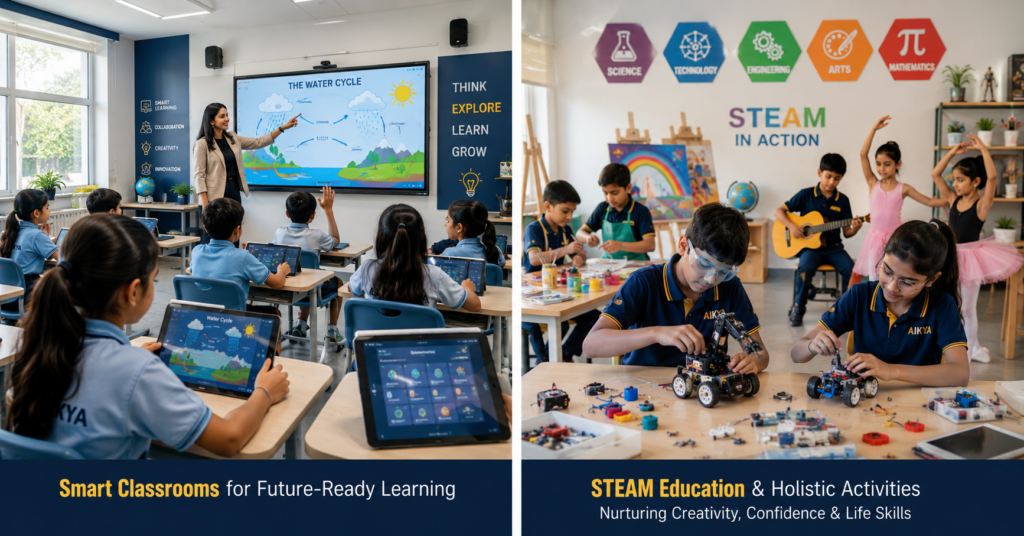
Technology can support learning, but simply having smart boards or computers does not necessarily mean a school is future-ready.
Look for opportunities for children to develop:
- Critical thinking
- Creativity
- Problem-solving
- Digital literacy
- Collaboration
- Responsible technology use
9. Fees and Additional Costs
Don’t compare schools only on the advertised annual fee.
Ask about additional costs such as:
- Transport
- Uniforms
- Books
- Activities
- Trips
- Technology programmes
- Other school-specific charges
Understanding the overall cost can help families make a more informed decision.
10. School Culture
Finally, think about whether the school’s values and environment are compatible with your family’s expectations.
A school should feel like a place where your child can learn, develop confidence, build relationships and gradually become more independent.
CBSE School Admissions in Bangalore: What Parents Should Know
CBSE is one of the most widely followed school curricula in India, and many Bangalore parents consider CBSE schools because of its structured national curriculum.
However, choosing a CBSE school should involve more than checking whether the school is affiliated with CBSE.
Parents should also explore:
- How the curriculum is implemented
- Teaching and assessment methods
- Opportunities for experiential learning
- Sports and co-curricular activities
- Student support
- Technology integration
- Teacher-student interaction
- School culture
A CBSE curriculum can provide a strong academic foundation, but examinations such as JEE and NEET require dedicated preparation beyond the school curriculum.
Parents should therefore look at the overall learning environment, rather than assuming that the board alone determines a child’s future outcomes.
If you’re comparing school boards, you can also read our guide on CBSE vs ICSE: Which Board Is Better for Your Child?
School Admissions in South Bangalore
For families living in South Bangalore, location can be an important part of the school-selection decision.
Parents may explore schools in and around areas such as:
- Jayanagar
- JP Nagar
- Banashankari
- BTM Layout
- Koramangala
- Bannerghatta Road
- Kanakapura Road
The right location depends on where your family lives and how much daily travel is practical for your child.
Why should parents consider commute carefully?
A long daily commute can affect a child’s routine, particularly when combined with homework, sports, activities and adequate sleep.
Instead of asking only:
“How far is the school?”
also consider:
“How long will my child actually spend travelling each day?”
For parents looking at CBSE schools in Jayanagar and South Bangalore, visiting shortlisted campuses can help you compare the learning environment as well as the practical commute.
School Visit Checklist for Parents
A school website can provide useful information, but a campus visit gives you the opportunity to experience the environment first-hand.
Take this checklist with you:
☐ What curriculum does the school follow?
☐ How are students taught and assessed?
☐ What is the student-teacher ratio?
☐ How does the school support different learning needs?
☐ What sports and co-curricular activities are available?
☐ How much hands-on and experiential learning do students receive?
☐ How does the school approach technology?
☐ What safety and child-protection measures are followed?
☐ How does the school communicate with parents?
☐ What are the transport arrangements?
☐ What are the total fees and additional expenses?
☐ What does a typical school day look like?
Most importantly, observe the students.
Do they appear engaged? Are teachers approachable? Does the environment feel supportive and well organised?
These observations can be just as valuable as the answers provided during the school tour.
Suggested Admission Timeline
| Timeline | Activity |
| 10–12 Months Before | School research |
| 8–10 Months Before | Campus visits |
| 6–8 Months Before | Application submission |
| 3–6 Months Before | Assessments/interviews |
| Final Stage | Admission confirmation |
Common Mistakes Parents Make During School Admissions
Even well-prepared parents can make the process more stressful than it needs to be.
1. Starting the search too late
Waiting until the academic year is about to begin can limit your options.
2. Choosing only based on reputation
A well-known school may not necessarily be the right fit for every child.
3. Focusing only on fees
The cheapest or most expensive option isn’t automatically the best choice.
4. Ignoring the commute
Daily travel can significantly affect your child’s routine.
5. Not checking eligibility first
Parents sometimes begin an application without confirming age or grade eligibility.
6. Comparing schools only through websites
A campus visit can reveal important differences in school culture and learning environment.
7. Looking only at academics
Academic achievement matters, but children also need opportunities to develop communication, confidence, creativity, physical fitness and social skills.
8. Treating technology as the definition of future-ready education
A future-ready school should help children think, question, create, collaborate and solve problems, not simply use more devices.
How Early Should You Apply?
There is no single answer that applies to every school.
Some schools begin admissions well in advance, while others may open applications according to grade-wise availability.
For 2027–28, parents should ideally begin researching schools during 2026 rather than waiting until the last minute.
However, early research does not mean rushing into a decision.
Use the additional time to:
- Shortlist schools.
- Understand the curriculum.
- Check eligibility.
- Visit campuses.
- Compare learning approaches.
- Understand the total cost.
- Ask questions.
- Speak to the admissions team.
- Make a decision based on your child’s needs.
Making informed decisions early reduces admission stress significantly.
Final Thoughts
School admissions in Bangalore can feel complicated when parents try to compare every school, curriculum and admission process at once.
The process becomes much easier when you break it down into a few important questions:
Is the school suitable for my child’s learning needs?
Is the curriculum right for our family’s plans?
Can my child manage the daily commute?
Does the school provide opportunities beyond academics?
Does the school environment feel safe, supportive and engaging?
And perhaps most importantly:
Can I see my child growing and becoming confident in this environment?
For families exploring CBSE schools in Jayanagar and South Bangalore, Aikya World School offers a learning environment that combines academic foundations with 21st-century skills, experiential learning and hands-on STEAM experiences.
Parents can visit the campus, understand the learning approach and speak with the admissions team before making a decision.
FAQ’s
When do school admissions start in Bangalore?
Most schools begin admissions between October and January for the next academic year.
What documents are required for school admissions?
Schools usually require birth certificate, Aadhaar card, photographs, report cards, and address proof.
How early should parents apply for school admissions?
Parents should ideally begin researching schools 6–10 months before admissions open.
Why do parents prefer CBSE schools in Bangalore?
CBSE schools support conceptual learning and competitive exam preparation like JEE and NEET.
What should parents look for in a school?
Parents should evaluate academics, infrastructure, faculty, safety, sports, and holistic development opportunities.