
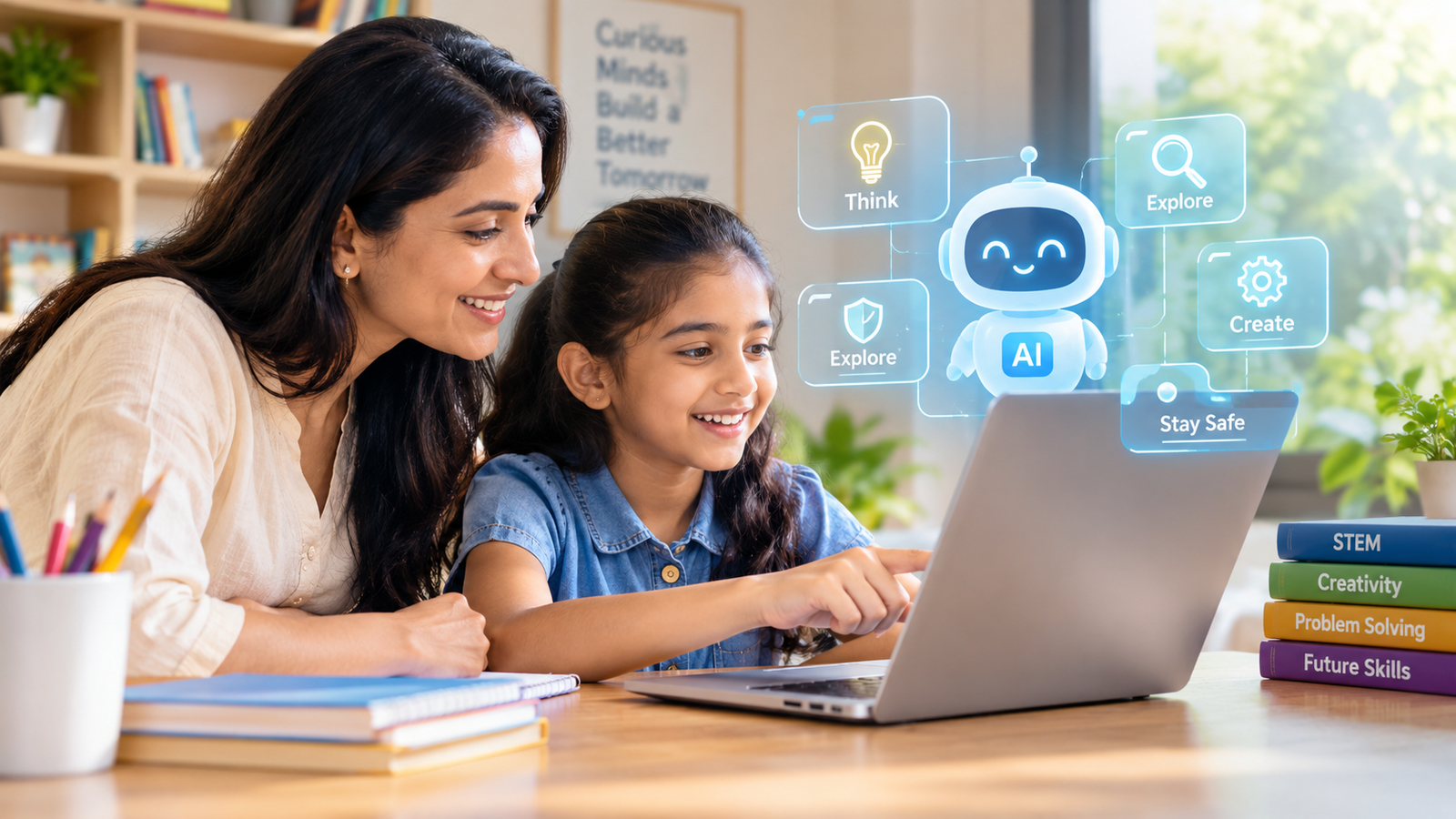
Artificial intelligence is already becoming part of children’s everyday lives. From search engines and recommendation systems to chatbots and educational apps, children may encounter AI long before they fully understand how it works.
That can leave parents wondering: Should I restrict AI, teach my child to use it, or do both?
The answer is not simply about screen time. AI and children is ultimately a conversation about skills how children think, question information, protect themselves online and use technology without allowing it to replace their own judgement.
UNICEF reports that up to 50% of surveyed children across 10 countries were already using AI, while children were more than three times as likely as their parents or caregivers to use AI systems.
So what should parents teach now?
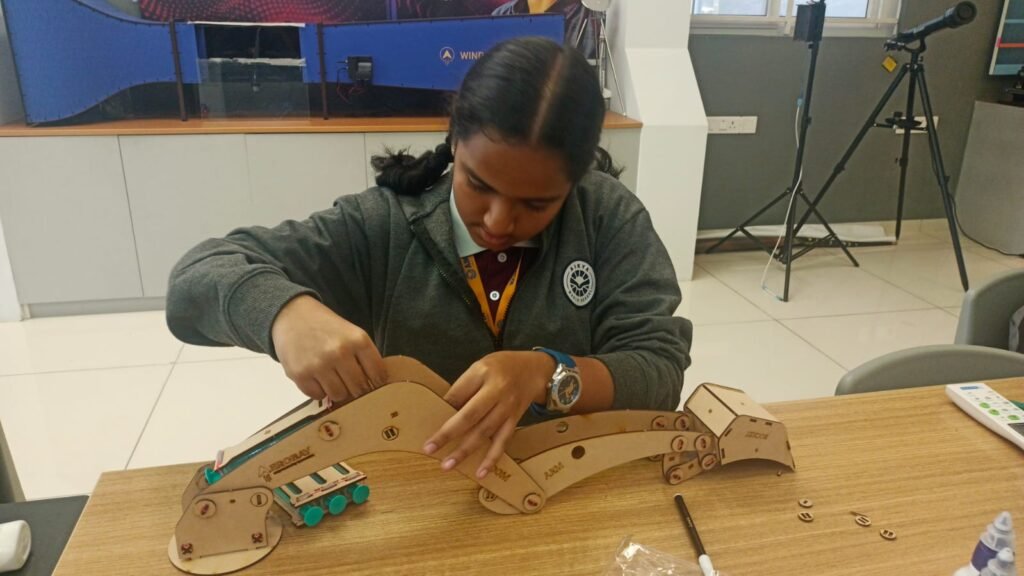
What Skills Should Parents Teach Children About AI?
1. Critical Thinking
AI can produce an answer quickly, but quick does not always mean correct.
Teach children to ask:
- Is this information accurate?
- What evidence supports it?
- Can I verify it somewhere else?
- Could the AI be wrong?
2. AI Literacy
Children don’t need to become programmers to understand AI.
They should gradually learn what AI is, how it uses data and what it can and cannot do.
3. Creativity
AI can generate stories, images and ideas within seconds. But children still need to develop their own imagination.
Encourage children to think first, create their own ideas and then use AI as a tool to explore or improve them.
That keeps technology connected to creativity rather than replacing it.
4. Problem-Solving
Instead of asking AI to solve every problem, encourage children to attempt a solution themselves first.
For example, if a child has a difficult school problem, ask:
“What do you think the answer might be? Show me how you worked it out.”
AI can then be used to compare approaches or explain a difficult concept.
5. Digital Safety and Privacy
Children should understand that they should never casually share sensitive information with an AI tool.
Teach them to protect:
- Full names and addresses
- Passwords
- School details
- Personal photographs
- Private conversations
- Family information
6. Ethical Thinking
Children should understand that technology affects real people.
Simple questions can build ethical awareness:
“Is this fair?”
“Could this hurt someone?”
“Should we use AI for this?”
7. Communication
AI may help children write, but children still need to speak, listen, explain and collaborate with real people.
Encourage conversations, presentations, teamwork and face-to-face interaction alongside digital learning.
8. Independent Learning
One of the biggest parenting concerns is dependence on AI.
If children turn to AI whenever something becomes difficult, they may miss the productive struggle that helps them learn.
The goal should be to use AI as a learning assistant, not an answer machine. UNICEF has similarly identified concerns around children offloading learning responsibilities to AI.
9. Adaptability
Technology will continue changing.
Rather than teaching children one particular AI tool, help them develop the confidence to learn new tools, question them and adapt when technology changes.
10. Human Skills
Perhaps the most important lesson is that not everything should be handed over to technology.
Children still need:
- Empathy
- Curiosity
- Patience
- Teamwork
- Emotional awareness
- Decision-making
- Resilience
These human qualities help children use technology wisely rather than become dependent on it.
How Can Parents Introduce AI at Home?
Start With Curiosity
Parents don’t need to be AI experts. Explore age-appropriate examples together and ask children what they think AI can and cannot do.
Create Simple Family Rules
A few clear rules can help:
- Don’t share private information.
- Check important AI-generated information.
- Don’t copy AI answers as your own work.
- Ask an adult when something feels confusing or unsafe.
- Keep real-world learning, play and relationships at the centre.
What Should Parents Look for in a School?
Look Beyond “AI Classes”
A school doesn’t necessarily need a separate AI subject to prepare children for the future.
Parents should look for evidence of critical thinking, creativity, problem-solving, experiential learning, digital literacy and responsible technology use.
Ask About Learning in Practice
During a school visit, ask:
- Do students solve real-world problems?
- Are they encouraged to ask questions?
- Do they work collaboratively?
- Are technology and STEAM integrated into learning?
- How does the school approach responsible technology use?
These questions can reveal more than simply asking whether a school “teaches AI.”
Top 3 Approaches Parents Can Learn From
Different education organisations are approaching AI and children from different perspectives.
UNICEF focuses strongly on child rights, safety, privacy, participation and AI literacy.
UNESCO emphasises human-centred AI competencies, ethics, critical judgement and responsible participation.
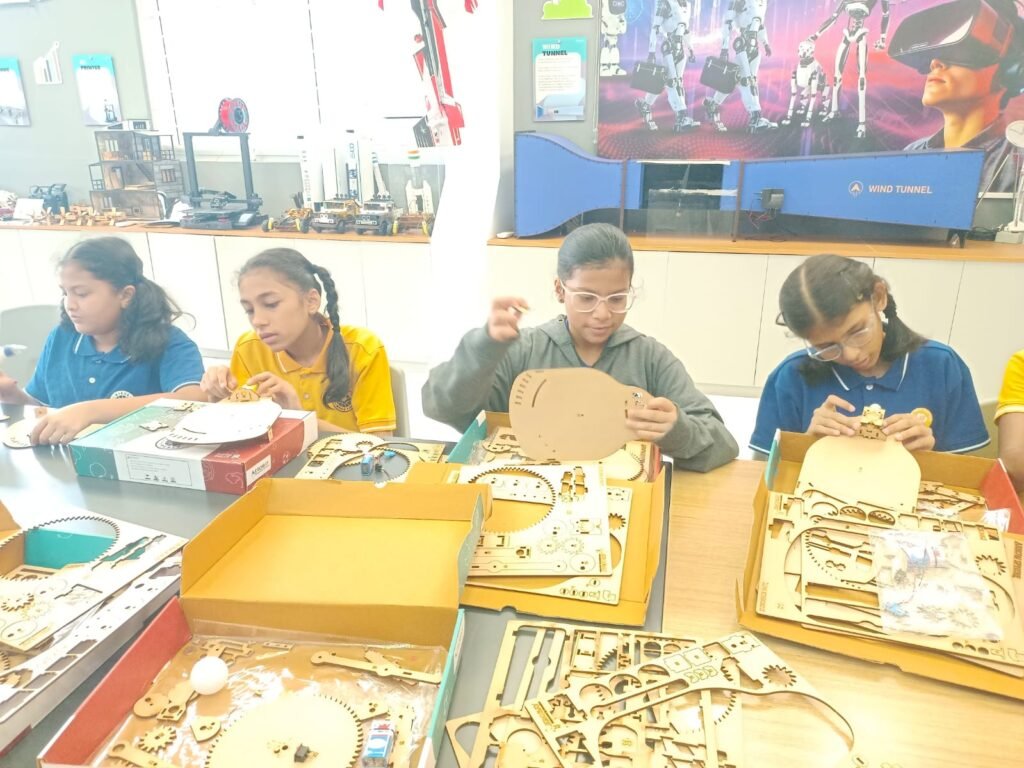
Hands-on education initiatives encourage children to move from simply using AI to experimenting, building and solving real problems. UNICEF’s “Tinkering with Tech” initiative is one example of this approach.
The common lesson is clear: children need more than technical familiarity. They need the judgement and skills to use technology responsibly.
Final Thoughts
The conversation around AI and children should not be reduced to whether children should use technology or avoid it.
The more useful question is: What kind of thinkers do we want our children to become in an AI-powered world?
Children who can question information, protect their privacy, think creatively, solve problems and make ethical decisions will be better prepared to navigate changing technology.
That is why parents should look for schools that combine technology with holistic learning, human skills, experiential education and strong academic foundations.
At Aikya World School, Jayanagar, the learning approach includes 21st-century skills, experiential learning and hands-on STEAM experiences. Parents exploring schools in South Bangalore can visit the campus and understand how learning extends beyond textbooks.
Planning your child’s next step? Visit the Aikya campus, speak with the admissions team and make an informed decision about your child’s learning environment.
FAQs
What is AI literacy for children?
AI literacy means understanding what artificial intelligence is, how it works at a basic level, where it can be useful and what risks or limitations children should recognise.
At what age should parents teach children about AI?
There is no single starting age. UNICEF guidance notes that parents can begin age-appropriate conversations quite young, particularly because children already encounter AI in everyday technologies.
Is AI safe for children?
AI can provide useful learning opportunities, but risks include privacy concerns, inaccurate information, inappropriate content and overdependence. Age-appropriate supervision and clear boundaries are important.
Should children use AI for homework?
AI can support learning when used appropriately, but children should still attempt to understand and complete their work themselves rather than simply submitting AI-generated answers.
What are the most important AI skills for students?
Critical thinking, AI literacy, creativity, problem-solving, digital safety, ethical reasoning, communication and adaptability are among the important skills.
How can parents teach responsible AI use?
Explore AI together, establish privacy and usage rules, encourage fact-checking and make sure technology complements rather than replaces reading, thinking, conversation and hands-on learning.