
Introduction: Why Do the Preschool Years Matter So Much?
Children between the ages of 3 and 5 are developing rapidly. They are learning to communicate, manage emotions, interact with others, solve simple problems and become more independent. The CDC describes preschool as a period when children’s social, emotional, language and physical abilities continue to develop quickly.
That is why the right parenting tips for preschoolers are not about making your child “perfect.” They are about creating a secure environment where your child can learn, make mistakes, try again and gradually become more confident.
And if your child is preparing to enter preschool or move into the next stage of schooling, these habits become even more important. School admissions can feel urgent, particularly when families are comparing schools and planning for the coming academic year. But choosing a school is only one part of school readiness. The habits you build at home matter just as much.
10 Parenting Tips for Preschoolers That Actually Work
Here are 10 practical strategies parents can start using at home.
1. How Can You Build a Predictable Daily Routine?
Preschoolers feel more comfortable when they know what comes next.
A consistent routine for waking up, meals, play, school, bath and bedtime gives children a sense of security. It can also make transitions easier.
Try creating a simple routine such as:
- Wake up
- Brush and get ready
- Breakfast
- School
- Lunch
- Rest or quiet time
- Outdoor play
- Family time
- Dinner
- Story and bedtime
You do not need to follow every minute rigidly. The important thing is consistency.
Parent tip: Use pictures for younger children. A visual routine can help them understand what happens next without repeated instructions.
2. How Can You Encourage Independence Without Leaving Your Child Alone?
Preschoolers often say, “I can do it myself!”
Let them.
Independence develops when children get opportunities to complete small tasks appropriate for their age.
Encourage your child to:
- Put toys away
- Choose between two outfits
- Carry their own small bag
- Help set the table
- Put dirty clothes in the basket
- Wash their hands
- Try dressing themselves
- Pack simple items with your supervision
The CDC recommends allowing preschoolers to participate in simple chores and offering limited choices to encourage independence.
Why does this matter?
Small responsibilities teach children that they are capable.
Instead of saying, “Let me do it; you’re too slow,” give them a little extra time.
That patience today can become confidence tomorrow.
3. How Should Parents Handle Preschool Tantrums?
Tantrums can test even the calmest parent.
When a preschooler is overwhelmed, long explanations rarely work. First help the child calm down. Then talk about what happened.
Try:
“I know you’re upset. It’s okay to feel angry. It’s not okay to hit.”
This separates the emotion from the behaviour.
Your child learns that feelings are acceptable, while hurting others is not.
The American Academy of Pediatrics recommends calm, consistent discipline, clear limits, modelling appropriate behaviour and helping preschoolers learn better ways to handle strong emotions.
What should you avoid?
- Shouting
- Humiliating the child
- Threatening
- Physical punishment
- Calling the child “bad”
Positive discipline is about teaching, not simply stopping behaviour.
4. How Can You Help Your Child Develop Strong Communication Skills?
Talk to your child throughout the day.
You do not need special educational materials. Ordinary conversations are powerful learning opportunities for preprimary programme.
Ask questions such as:
- “What did you enjoy at school today?”
- “What do you think will happen next?”
- “Why do you think the character is sad?”
- “Which one is bigger?”
- “How would you solve this?”
Give your child time to answer.
5. How Important Is Reading Every Day?
A daily reading habit can become one of the simplest and most valuable parenting routines.
You do not have to finish a long story every night. Even 10–15 minutes of focused reading can become meaningful family time.
While reading, ask:
- “What do you see?”
- “What do you think happens next?”
- “How does she feel?”
- “What would you do?”
The CDC recommends continuing to read to preschool children and nurturing their interest in books.
Make reading enjoyable
Let your child choose some books.
Use different voices.
Point to pictures.
Allow questions.
The goal is not to finish the book quickly. The goal is to help your child develop a love for stories and learning.
6. How Can Play Help Your Preschooler’s Development?
Play is not wasted time.
For young children, play is a major way of exploring the world.
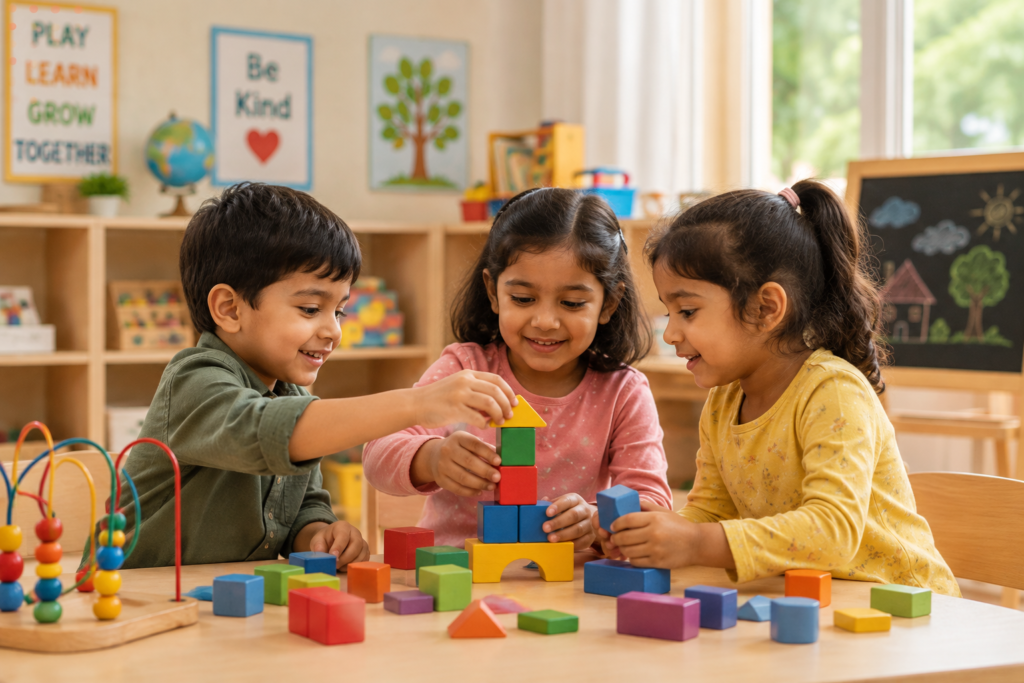
A child building a tower is learning about balance. A child playing pretend is developing imagination and communication. A child playing a simple game with another child is practising turn-taking and cooperation.
India’s National Curriculum Framework for the Foundational Stage specifically recognises play, activity, exploration and inquiry as central to children’s learning and development.
Encourage different forms of play:
- Pretend play
- Outdoor games
- Building blocks
- Drawing and crafts
- Puzzles
- Music and movement
- Storytelling
- Nature exploration
Remember
You do not need expensive toys.
Sometimes a cardboard box, crayons and imagination provide more meaningful engagement than a complicated electronic toy.
7. How Can You Teach Social Skills at Home?
Preschoolers are still learning how to share, cooperate and resolve disagreements.
Do not expect perfect social behaviour immediately.
Instead, practise social skills through everyday situations.
Teach your child to:
- Wait for a turn
- Say “please” and “thank you”
- Ask before taking something
- Listen when another person speaks
- Help others
- Apologise when appropriate
- Express disagreement without hitting
Arrange opportunities for your child to play with other children.
The CDC notes that playing with other children helps preschoolers develop sharing and friendship skills.
8. How Can Parents Build Healthy Screen Habits?
Screens can be useful, but they should not replace sleep, physical activity, conversations, reading or play.
For preschoolers, create clear family rules around devices.
For example:
- Keep screens away during family meals.
- Avoid using devices as the automatic solution to boredom.
- Keep televisions and devices out of the child’s bedroom.
- Choose age-appropriate content.
- Protect time for outdoor play and family interaction.
The CDC’s current preschool guidance recommends limiting screen exposure and developing a family media plan.
The key is not simply counting minutes. Think about what screen time is replacing.
9. How Can You Encourage Healthy Eating and Sleep?
A tired or hungry child can find emotional regulation much harder.
Preschoolers benefit from predictable meals, nutritious food, physical activity and sufficient sleep.
The CDC states that children aged 3–5 generally need 10–13 hours of sleep in a 24-hour period, including naps.
Build simple healthy habits
- Maintain regular mealtimes.
- Offer a variety of nutritious foods.
- Encourage water.
- Make physical activity part of the day.
- Keep a predictable bedtime.
- Create a calming bedtime routine.
- Read instead of using screens before sleep.
You do not have to make every meal perfect.
Consistency matters more than perfection.
10. How Can Parents Work With Teachers for Better Child Development?
Parents know their child in one environment.
Teachers see the child in another.
Both perspectives matter.
A strong parent-teacher relationship can help adults understand a child’s interests, strengths, challenges and progress more clearly.
Share useful information with teachers, such as:
- Changes in routine
- New interests
- Emotional concerns
- Learning preferences
- Social difficulties
- Important family changes
And listen to the teacher’s observations without immediately becoming defensive.
The goal is not to ask, “Who is right?”
The goal is to ask:
“What can we do together to help this child?”
What Does the Research Say About Preschool Development?
UNICEF India highlights the importance of responsive relationships, stimulation, communication, play, routines and nurturing care in early childhood. Its guidance for children aged 2–4 specifically recommends talking and listening, structuring the day, playing, setting boundaries and limiting digital media during interactions.
The Government of India’s National Curriculum Framework for the Foundational Stage defines the foundational stage as ages 3–8 and emphasises physical, cognitive, socio-emotional, communication, literacy and numeracy development through play and activity-based learning.
Key statistics parents should know
- 3–5 years: The CDC identifies this as the preschool age range and tracks developmental milestones across play, learning, language, behaviour and movement.
- 10–13 hours: Recommended sleep in 24 hours for preschoolers aged 3–5, including naps.
- Age 3–8: India’s Foundational Stage framework covers five years from preschool through Grade 2.
- Play-based learning: India’s foundational-stage framework places play and activity at the centre of learning and development.
These figures are useful reminders that healthy development depends on more than academic practice.
How Can the Right School Support Your Parenting Goals?
Choosing a school becomes an important decision when your preschooler is ready for the next step.
Look beyond attractive infrastructure or academic promises.
Ask:
- Are children encouraged to ask questions?
- Is learning age-appropriate?
- Are teachers approachable?
- Are play, arts and physical activity part of school life?
- How does the school communicate with parents?
- What opportunities are there for creativity and exploration?
India’s foundational-stage framework encourages flexible, play-based, activity-based and inquiry-based learning rather than an approach focused only on rote academic instruction.
For families exploring schools in Jayanagar and South Bangalore, this is particularly relevant when comparing early-years programmes.
Aikya World School describes its approach as combining academics with personal, social and emotional development, alongside experiential learning and 21st-century skills.
Final Thoughts: Small Parenting Habits Can Shape Big Futures
The best parenting tips for preschoolers are not about achieving perfect behaviour. They are about building a foundation of confidence, curiosity, emotional security, independence and healthy relationships.
When parents combine nurturing care at home with a supportive school environment, children get stronger opportunities to develop academically, socially, emotionally and physically.
That is the heart of holistic learning.
If you are exploring the next educational step for your child in Jayanagar or South Bangalore, take time to look beyond rankings and advertisements. Visit the campus, understand the learning environment, speak with educators and ask whether the school’s philosophy matches your child’s needs.
At Aikya World School, parents can explore a learning environment that places emphasis on holistic development, experiential learning, emotional well-being and 21st-century skills.
Explore School Admissions at Aikya World School
Ready to explore the right learning environment for your child?
- Schedule a campus visit
- Submit an admissions enquiry
- Speak directly with the admissions team
- Explore the school’s pre-primary programme
Frequently Asked Questions
1.What are the best parenting tips for preschoolers?
The most useful parenting tips for preschoolers include maintaining a predictable routine, using positive discipline, encouraging independence, reading daily, providing opportunities for play, teaching social skills, setting screen-time boundaries and communicating regularly with teachers.
2.How can I prepare my child for preschool?
Practise simple self-help skills, establish a regular morning routine, introduce school-related activities, visit the school if possible and create a predictable goodbye routine. Talk positively about school without dismissing your child’s worries.
3.How much sleep does a preschooler need?
Children aged 3–5 generally need 10–13 hours of sleep in 24 hours, including naps, according to current CDC guidance.
4.How important is play for preschool children?
Play is essential to early childhood learning. Through play, children can practise communication, creativity, problem-solving, physical coordination and social interaction. India’s Foundational Stage framework identifies play and activity as primary ways children learn and develop.
5.Should parents be involved in their child’s preschool education?
Yes. Parents and teachers see different aspects of a child’s development. Regular communication can help both understand the child’s strengths, interests and challenges and create more consistent support between home and school.